
CLEAN CARE Multinational Tabletop Exercise Strengthens CBRN Medical Readiness and Interoperability
Military and civilian medical and Chemical, Biological, Radiological and Nuclear (CBRN) defence experts from 16 nations have gathered in Sweden for the CLEAN CARE multinational Tabletop Exercise (TTX), bringing together approximately 75 participants from NATO Allies and partner nations.

75 participants from 16 nations gathered in Sweden for the CLEAN CARE multinational Tabletop Exercise.
Photo: Gustaf RydeliusHosted by Sweden, the exercise provides a multinational forum in which medical and CBRN specialists can examine some of the most demanding challenges associated with the management of casualties in a contaminated operational environment.
“CLEAN CARE is of great value to Sweden as a new NATO member testing our abilities to supply and coordinate joint operations with our NATO allies, especially in a CBRN environment. Apart from the multinational perspective we are also challenging our national structures in this specific threat environment, which is unfortunately of ever-increasing importance,” says Captain Erik Salaneck of the Center for Defence Medicine in the Swedish Armed Forces and the main exercise planner for CLEAN CARE from Sweden.
The exercise is conducted within a collective-defence scenario based on Article 5 of the North Atlantic Treaty, centred on operations in and around Gotland and the Baltic Sea. The scenario challenges participants to address the complex interaction between CBRN defence, medical support, casualty management and evacuation, while operating within the constraints of a contested and resource-limited environment.
Exercise CLEAN CARE is an established component of NATO's efforts to develop and improve medical preparedness for CBRN incidents. The exercise provides a unique opportunity to bring together different national approaches, capabilities and professional perspectives, identify interoperability challenges, and contribute to the continued development of NATO medical concepts, doctrine, training and procedures.
Particular emphasis during this iteration is placed on the management of CBRN casualties throughout the medical evacuation and treatment chain in close cooperation with Swedish and Danish civil authorities in an effective CIV-MIL cooperation, including contamination control, casualty decontamination, medical treatment, patient flow and the prevention of secondary contamination of medical personnel, facilities and evacuation assets.
The multinational composition of the exercise is particularly valuable. The participation of experts from 16 nations, both NATO and non-NATO, allows CLEAN CARE to go beyond the testing of procedures. It creates an environment in which participants can compare national concepts, identify practical solutions and build the professional relationships required to respond effectively to complex CBRN incidents.
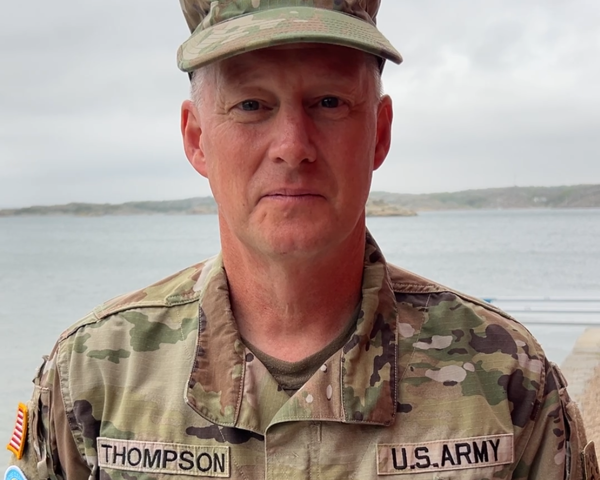
Lieutenant Colonel Aaron Thompson US Army, Co-Chair of the NATO CBRN Medical Training Panel.
Photo: Gustaf Rydelius“CBRN medical support is, by definition, a multidisciplinary and multinational challenge. No single nation, medical service or specialist community can address it in isolation. CLEAN CARE allows us to bring operational CBRN defence and military medicine together, challenge our assumptions, and identify practical solutions that can work across national boundaries. Ultimately, our objective is simple: to preserve life while maintaining medical and operational capability in the most demanding operational conditions,” says Lieutenant Colonel Aaron Thompson US Army, Co-Chair of the NATO CBRN Medical Training Panel and Officer Conducting the Exercise.
The exercise is scheduled under the auspices of the NATO Committee of the Chiefs of Military Medical Services (COMEDS) and is made possible through the combined expertise and commitment of a broad multinational community.
“As the Officer Conducting the Exercise, I would like to express my sincere appreciation to Sweden, as Host Nation, for its outstanding support and hospitality, and to all participating nations for providing highly qualified personnel and subject-matter expertise“.
“I would also like to acknowledge the contribution of the NATO Centre of Excellence for Military Medicine (NATO MILMED COE), Multinational Medical Coordination Centre-Europe (MMCC-E) and the NATO Joint Chemical, Biological, Radiological and Nuclear Defence Centre of Excellence (JCBRN Defence COE), together with the NATO CBRN Medical Working Group, NATO CBRN Medical Training Panel, the Institute for Defense Analyses (IDA), United States, and the other organisations and commands contributing personnel and expertise to the Exercise Control (EXCON), including NATO Rapid Deployable Corps – Italy / Allied Reaction Force (NRDC-ITA/ARF). I offer a special acknowledgement to the governments of Sweden and Denmark for contributing specialist from their civil authorities allowing us to achieve our CIV-MIL cooperation objectives.”
“Their combined expertise, together with the active engagement of all participants, is essential to creating a realistic environment in which operational concepts can be challenged, national approaches compared and practical interoperability issues identified.”
“The value of CLEAN CARE lies not only in what happens during the exercise, but in what participants take back to their nations and organisations. The observations, discussions and lessons generated here will contribute to improving interoperability, refining procedures and strengthening the ability of Allied and partner medical services to protect the force, preserve medical capability, and save lives in a CBRN environment.”